
Examining Our Investment Experience
.webp)
By Ben Dolan, CFP®
2006 was an exciting year for me. I was living on the North side of Chicago, working in the finance district downtown, sailing on Lake Michigan on the weekend (my friend had a boat, a Tartan 10) and getting to Cubs games whenever I could score a cheap ticket.
2006 was also memorable because it was the first year I began investing in earnest. Having paid off my student loans the year before (which were minimal thanks to the financial discipline of my parents), I started investing for the long-term. Finally, I thought, after six years of college, I was ready to earn so I could save, save, save and watch compounding run wild!
I was serious about my desire to save. While most of my friends lived in or near the city, I lived on the far North side, a 45-minute train ride each way, to save on rent. The contents of my apartment were all free, given to me when friends of my sister decided to join the Peace Corp and didn’t want the hassle of selling their furniture. I saved a lot in 2006.
Then, from October 2007 through March of 2009, the S&P 500 lost 55.3% including reinvested dividends. The Great Recession was my introduction to investing in markets. To say I felt perturbed was putting it mildly (I also found it curious, began studying the history of market activity, and ultimately chose a career in investment management). And yet, my losses felt like nothing compared to those who were about to retire or were newly retired.
In his recent article for the Wall Street Journal, Jason Zweig notes how these experiences shape our outlook: “In economic theory, your attitude toward risk is supposed to remain stable, and you’ll use all relevant information when making investment decisions.
In the real world, your attitude toward risk depends partly on who you are, but also on what you’ve lived through. And the data you’ll rely on is a mix of recent history and whatever stands out most vividly from your own experience.”
For those of us participating in markets during and after the Great Recession (or the dot-com bubble, or black Monday, etc., etc.), it’s important to examine, 1) our emotions during that period, 2) the investment decisions that followed, and 3) the data post such a dramatic event.
Identifying our emotions is the easy part. I’m sure all felt scared, uncertain, angry, betrayed, or some combination of these. However, maybe the most important question you could ask yourself now is, how would you feel if a similar market event happened again?
Did you sell your stocks and move to the sidelines? Did you hit pause on your investments but not sell anything? Did you change anything at all? Did you begrudgingly buy more stocks? If you regret decisions you made, what would you do differently and why?
Return data following the Great Recession is fascinating. The panic drove markets to forward-looking price-to-earnings ratios near the single digits, well below their average of 16. This meant stocks were cheap. Investors pounced, and the S&P 500 had an excellent 12 months, gaining 43%, according to Perplexity.
In the chance the Great Recession had such a negative impact on your investment experience that you gave up US stocks for a while, you probably would not have been happy on the sidelines. Following 2008, the S&P 500 had only two years of negative returns from 2009 to 2025 (2018, down 4.38%, and 2022, down 18.11%). Here’s a chart:
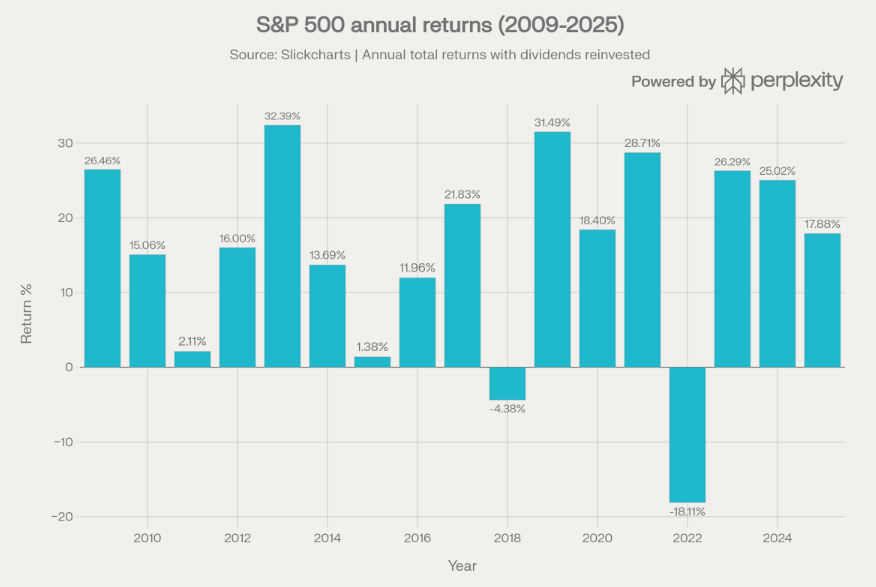
While not easy, I believe making good investment decisions requires examining and confronting our past investment mistakes, experiences, and biases. With an honest assessment of the past, you’ll be well prepared for what lies ahead, come what may.
The opinions voiced in this material are for general information only and are not intended to provide specific advice or recommendations for any individual. The market and economic data are historical and are no guarantee of future results. All indices are unmanaged and may not be invested into directly. The information in this report has been prepared from data believed to be reliable, but no representation is being made as to its accuracy and completeness.
Nothing in this material should be construed as investment advice offered by Dolan Capital Advisors, Inc. This market commentary is for informational purposes only and is not meant to constitute a recommendation of any particular investment, security, portfolio of securities, transaction, or investment strategy. No chart, graph, or other figure provided should be used to determine which securities to buy, sell or hold. No representation is made concerning the appropriateness of any particular investment, security, portfolio of securities, transaction, or investment strategy. You should speak with your own financial professional before making any investment decisions.
Past performance is not indicative of future results. Dolan Capital Advisors, Inc. does not guarantee any specific outcome or profit. These disclosures cannot and do not list every conceivable factor that may affect the results of any investment or investment strategy. Risks will arise, and an investor must be willing and able to accept those risks, including the loss of principal.
Certain statements contained herein are statements of future expectations and other forward-looking statements that are based on opinions and assumptions that involve known and unknown risks and uncertainties that would cause actual results, performance, or events to differ materially from those expressed or implied in such statements.
Ben Dolan and Michael Foster are investment advisor representatives of Dolan Capital Advisors, Inc., a SEC-registered investment adviser. Investment advice offered through Dolan Capital Advisors, Inc.